I'm a bit stuck on my math. It's rather simple stuff, but I'm re-taking the course and forgot most of it - and the textbook isn't helping much.
I need to find the mean (average) of the following data set:
The first 50 positive multiples of 3
and the two equations I'm given to use are
Sn = n * [2a + (n + 1) * d] / 2
and
Sn = a * (r^n - 1) / r - 1
But I can't remember what equation to use, or what numbers to use for each variable. I think n would = 3 here, but I'm in need of a description of how to find these numbers - if anyone remembers. xD; or even if someone just has a site to point me to that'd help me figure it out.
Homework Help Thread--SPLIT
Moderator: Moderators
-
Moonlight Flower
- PPT Trainee

- Posts: 650
- Joined: Wed Oct 27, 2004 2:35 pm

-
pipsqueeek
- PPT God

- Posts: 1842
- Joined: Mon Oct 03, 2005 4:46 pm
- Location: sleep deprivation
I'm not quite sure what those formulas are saying, but here's how I'd solve the problem.
I'd find the sum of the first 50 multiples of 3 by finding the sum of the first 50 integers and multiplying by three
(3+6+9+...+150 = 3*1+3*2+3*3+...+3*50 = (1+2+3+...+50)*3)
There's a handy little formula for finding the sum of the first n number, n(n+1)/2. SO plug 50 in for n and multiply by 3 to find the sum of the first 50 positive multiples of 3, and then divide by 50 to find the mean.
I'd find the sum of the first 50 multiples of 3 by finding the sum of the first 50 integers and multiplying by three
(3+6+9+...+150 = 3*1+3*2+3*3+...+3*50 = (1+2+3+...+50)*3)
There's a handy little formula for finding the sum of the first n number, n(n+1)/2. SO plug 50 in for n and multiply by 3 to find the sum of the first 50 positive multiples of 3, and then divide by 50 to find the mean.

 Laq
Laq-
Hunter Lupe
- Administrator

- Posts: 1140
- Joined: Mon May 31, 2004 1:36 pm
- Contact:
Moonlight Flower wrote:I'm a bit stuck on my math. It's rather simple stuff, but I'm re-taking the course and forgot most of it - and the textbook isn't helping much.
I need to find the mean (average) of the following data set:
The first 50 positive multiples of 3
and the two equations I'm given to use are
Sn = n * [2a + (n + 1) * d] / 2
and
Sn = a * (r^n - 1) / r - 1
But I can't remember what equation to use, or what numbers to use for each variable. I think n would = 3 here, but I'm in need of a description of how to find these numbers - if anyone remembers. xD; or even if someone just has a site to point me to that'd help me figure it out.
The formulas you've provided are for the sums of arithmetic (n'th term = a+d*(n-1)) and geometric (n'th term = a*r^(n-1)) series, in that order.
The sequence you're looking at, the first 50 positive multiples of 3 is arithmetic (3, 6, 9 ...). So the nth term would be:
un = 3n = 3 + 3 * (n-1)
The mean of an arithmetic sequence can be found by adding the minimum and maximum values and dividing by 2; so you have:
Mean = (umin + umax) / 2
Mean = (a + (a + d*(n-1)) / 2
Mean = (2a + d*(n-1)) / 2 [a is the first number of your sequence (3), n is the number of numbers in the sequence (50), and d is the difference between two subsequent numbers (3)]
Mean = (6 + 3*49) / 2 = (153 / 2) = 76.5

Will you stop with the honour stuff?
-
Moonlight Flower
- PPT Trainee
- Posts: 650
- Joined: Wed Oct 27, 2004 2:35 pm


-
pipsqueeek
- PPT God
- Posts: 1842
- Joined: Mon Oct 03, 2005 4:46 pm
- Location: sleep deprivation
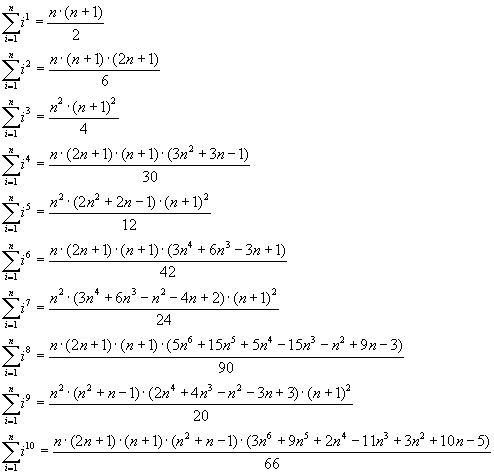
http://polysum.tripod.com/Sum_Formulas.gif
Yay for google.
Edit// ack, didn't realise it was one picture for all of them. Oh well. It's a ten for the price of one deal
Yay for google.
Edit// ack, didn't realise it was one picture for all of them. Oh well. It's a ten for the price of one deal
Laq-
Inexistence
- PPT God
- Posts: 1013
- Joined: Sun Jan 02, 2005 3:04 am
- Location: T3h England
This isn't really homework, but work I'm doing at home.
I have these figures for the x data:
837
770
330
991
648
And these for the y:
11
2
17
4
36
And I looked for somewhere that could find me a relationship (837 to 11, 770 to 2) and it came back with r(xy)=-0.472776
I need to know how it came to that relationship and why.
Cheers.
I have these figures for the x data:
837
770
330
991
648
And these for the y:
11
2
17
4
36
And I looked for somewhere that could find me a relationship (837 to 11, 770 to 2) and it came back with r(xy)=-0.472776
I need to know how it came to that relationship and why.
Cheers.

set by whhattisthiss. Thanks!
-
save_the _endangered_anim
- PPT Toddler

- Posts: 171
- Joined: Tue Jan 18, 2005 11:23 am
- Location: A place you never heard of, NJ
- Contact:
Hi, I need comments on a thesis for a seventh-grade NHD. It must be one sentence, and I don't like what i have so far. Can anyone help me? This year's theme is triumph and tragedy.
Alfred Nobel's patent of dynamite in 1867 was first perceived as an improvement over nitroglycerin and was intended to create world peace, but actually paved the way to greater human destruction and devastation.
Alfred Nobel's patent of dynamite in 1867 was first perceived as an improvement over nitroglycerin and was intended to create world peace, but actually paved the way to greater human destruction and devastation.

-
save_the _endangered_anim
- PPT Toddler
- Posts: 171
- Joined: Tue Jan 18, 2005 11:23 am
- Location: A place you never heard of, NJ
- Contact:
 . Synonymous with cranky teachers for us.
Well first time I come here >.< My math teacher is useless and I've been able to go through the year without any trouble. Now he throws something we never learnt (which is probably really easy) and thinks everyone knows what they should do...
11^(x+7) = 2^(7x)
(here is what i did so far)
11^(x+7) = 2^(7x)
11^(x+7) = 128^(x)
11^(x) + 11^(7) = 128^(x)
11^(x) + 19487171 = 128^(x)
11^(x+7) = 2^(7x)
(here is what i did so far)
11^(x+7) = 2^(7x)
11^(x+7) = 128^(x)
11^(x) + 11^(7) = 128^(x)
11^(x) + 19487171 = 128^(x)

IDB Supermod and Rater

Benladesh, you're going to want to use logarithms to solve that problem 
I'm not sure how much you know about logarithms, but one basic rule of them is that any exponent of a number is multiplied to the log of that number. (There should be a log function on your calculator, or on the internet somewhere)
Example:
2^a would be alog2 and 7^3x would be 3xlog7
So:
11^(x+7)=2^(7x)
(x+7)log(11)=(7x)log(2)
I hope that this helps, and feel free to PM me if you need to
I'm not sure how much you know about logarithms, but one basic rule of them is that any exponent of a number is multiplied to the log of that number. (There should be a log function on your calculator, or on the internet somewhere
)
Example:
2^a would be alog2 and 7^3x would be 3xlog7
So:
11^(x+7)=2^(7x)
(x+7)log(11)=(7x)log(2)
I hope that this helps, and feel free to PM me if you need to

-
pipsqueeek
- PPT God
- Posts: 1842
- Joined: Mon Oct 03, 2005 4:46 pm
- Location: sleep deprivation
Yeah we learnt how to use logs and manipulate them but meh im still not getting this. i figured it out by making a graph for each and then finding the x intercept...but this log stuff just won't work.. I can't use my calculator because it automatically makes x become 1
the log function on a calculator is automatically log10 as well
the log function on a calculator is automatically log10 as well
IDB Supermod and Rater
-
pipsqueeek
- PPT God
- Posts: 1842
- Joined: Mon Oct 03, 2005 4:46 pm
- Location: sleep deprivation
What kind of calculator do you have? It sounds like you've got x set to equal 1. On a ti-89 you can fix this by going to f6 -> clear a-z. On a ti-83/4 it's probably something similar, not sure exactly what though. On anything else... not sure. Look for something similar I guess.
Most calculators have log base 10 and natural log functions. There's a way to mess around with them(logs, not the calculator) to get a different base... but I could never remember it.
Edit// on an 83/4, possibly something in memory(2nd +)? I don't want to mess around with anything since it's not my calculator, but it looks like it's probably something in there.
Most calculators have log base 10 and natural log functions. There's a way to mess around with them(logs, not the calculator) to get a different base... but I could never remember it.
Edit// on an 83/4, possibly something in memory(2nd +)? I don't want to mess around with anything since it's not my calculator, but it looks like it's probably something in there.
Laq